The Old Vicarage on Zetland Street is a surviving link with the household of Wakefield’s parish clergy. Its history involves much more than the often-repeated date of 1349. Behind that date are a royal religious foundation at Westminster, an archbishop’s detailed instructions for a priest’s accommodation and income, and a succession of named men whose careers connect Wakefield with medieval church government, the Wars of the Roses, Tudor religious change and the upheavals of the seventeenth century. Later come the households of Samuel Sharp and Charles Joseph Camidge, the purchase associated with Edward Green, and the building’s long life as a Conservative Club and commercial premises.[1] [2] [3]
Three histories overlap here: the history of the vicarage as an endowed church office, the history of the house and its physical fabric, and the history of the people connected with it. They are related, but they are not interchangeable. Being appointed Vicar of Wakefield does not prove uninterrupted residence in this particular building. A medieval requirement to provide a house does not date every surviving wall. A family memorial in the church or cemetery does not establish that the person commemorated died at the vicarage.
The account below follows the people and the building through successive periods, then examines the house’s underground reputation and the campaign over its future. Where the records provide names, dates, rooms, property rights or family relationships, those details are included. Source notes identify disagreements and gaps in the evidence.
Chapter 01Before the vicarage: the church, the rectory and royal patronage

Wakefield’s church was already an old institution when the vicarage was endowed in the fourteenth century. The cathedral’s official history records a church in the Domesday Book of 1086 and describes evidence for an earlier Saxon church discovered during work at the east end in 1900. In 1090, William II gave the church and land at Wakefield to Lewes Priory in Sussex; a Norman church followed. The church was rebuilt and reconsecrated in 1329, during the archiepiscopate of William de Melton.[4]
Before 1349, the principal clerical office was a rectory. J. W. Walker’s nineteenth-century history names Richard de Lethebroch, presented in June 1237; P. de Fyghelden, presented in 1242; William Oliver, rector in 1318; and William de Cusancia, presented in 1325. These are predecessors in the parish’s institutional history, not a verified list of occupants of the surviving Old Vicarage. Walker’s later additions also discuss earlier evidence for a rector called Catardus, illustrating how the known succession continued to change as documents were identified.[1, pp. 190, 319]
William de Cusancia’s career demonstrates how a parish living could be linked with appointments elsewhere. Walker records that he also held Lymming in the diocese of Canterbury and received leave of absence from the Archbishop of York in 1326 and again in 1327. It is therefore unsafe to imagine every medieval rector living continuously beside the church. The documents concern rights and duties, some of which were exercised through other clergy.[1, p. 190]
The decisive change came under Edward III. Walker prints the grant of the patronage of Wakefield and Dewsbury to the Dean and Canons of St Stephen’s Chapel at Westminster, dated 6 August 1348. These northern parishes formed part of the financial support for a royal religious establishment. The connection was institutional and economic: it does not mean that the Old Vicarage was itself a monastery or that Westminster’s canons lived there.[1, pp. 12–16]
On 30 November 1348, William de la Zouch, Archbishop of York, appropriated Wakefield’s church to St Stephen’s. A portion of its income was reserved for a vicar who would undertake the local pastoral work. The arrangement also reserved annual payments of twenty shillings to the archbishop and ten shillings to the Dean and Chapter of York. This division of responsibilities explains why a separate, properly supported vicarage became necessary.[1, pp. 14–16]
Chapter 02The foundation of 20 June 1349
The detailed ordinance establishing the vicarage was issued at Ripon on 20 June 1349. Walker reproduces its Latin text with an English translation. In this setting, “ordination of the vicarage” means the formal arrangement of the office, its income and its obligations; it is not a record of a building’s completion ceremony. The document required a perpetual secular vicar, meaning a priest outside a monastic religious order, who would personally reside and care for the parishioners.[1, pp. 17–25]
The accommodation clause is unusually informative. St Stephen’s was to provide, at its expense, a suitable residence as close to the church as could conveniently be achieved. The specified establishment included a hall, at least two chambers, a kitchen, a stable, a grange, accommodation for animals and necessary household uses, and a garden enclosed with a sufficient fence. The document envisaged a functioning household with storage and livestock facilities, not merely a bedroom and study.[1, p. 20]
The hall would have been the principal shared domestic space, while the chambers supplied more private accommodation. The grange and animal buildings belong to the practical economy of the establishment. These are interpretations of the listed functions, not a reconstruction of the present floor plan: the ordinance does not supply the dimensions, the orientation of the rooms or a drawing that can be matched directly to modern shop units.
The vicar’s income was equally specific. The ordinance assigned offerings and numerous smaller tithes, including payments connected with calves, lambs, foals, pigs, poultry, bees, wax, honey, fruit, garden and croft produce, and mills. Walker’s printed correction is worth observing: a phrase originally translated as “white hemp” should read “hemp, milk”. That small correction changes the meaning of an agricultural income list and is a reminder to use the book’s additions as well as its main text.[1, pp. 20–22, 317]
The college retained substantial other revenues. The settlement also considered income from woodland, iron mines and coal mines, with a specified share of certain receipts payable to the vicar. This is evidence that such revenues were contemplated within the parish’s financial arrangements; it is not evidence of mining beneath the vicarage itself. Nor should the word “grange” be expanded into a claim that every tithe listed was physically brought into this house.[1, pp. 21–23]
In return, the vicar had to support a chaplain at Wakefield and another at Horbury, together with customary ministers. He was to provide lights, lamps, bread and wine for worship and meet specified ecclesiastical payments. The residence therefore belonged to an organisation serving a wider parish. Its household economy and the church’s religious work were inseparable: income maintained the clergy, and the clergy supplied the services required by the foundation.[1, pp. 23–24]
The named canons behind the foundation
The University of York’s catalogue of the archbishops’ registers confirms the foundation in Register 10, folio 32 recto, entry 1, dated 20 June 1349 at the archbishop’s manor of Ripon. The next day’s appointment of Thomas de Drayton is recorded separately in Register 10, folio 30 verso, entry 3. The documents were not necessarily entered in the volume in strict date order.[25]
The appointment names John de Chesterfield, John de Maidstone and John de Buckingham, canons of St Stephen’s, as the men constituting its chapter while the dean’s office was vacant. This supplies individual participants behind the general phrase “Dean and College of St Stephen’s”. Their role was presentation to the living; the entry does not make them builders or residents of the Wakefield house.[25]
Chapter 03The first vicars and the fourteenth-century succession
Thomas de Drayton was instituted on 21 June 1349, the day after the ordinance. Walker identifies him as the first vicar presented by St Stephen’s and says that he died almost immediately. The later online extracts from Walker’s Wakefield history suggest the Black Death as the probable cause. His successor’s appointment establishes that his tenure was brief, but neither that chronology nor the plague context proves where he died or how much of the newly prescribed residence had been completed.[1, pp. 25, 190] [3]
Henry de Grenehod, described as a chaplain, followed on 8 October 1349, explicitly on Drayton’s death. John de Whytelay was instituted on 11 May 1362. These names and dates are drawn by Walker from the archbishops’ registers. They provide a firm outline of succession, but the published entries offer little domestic biography.[1, p. 190]
John Stadefete was instituted on 6 August 1369. Walker records an exchange between his Wakefield living and Barton in the diocese of Norwich. William Woderove, formerly rector of Barton, became Vicar of Wakefield on 26 May 1372. An exchange of livings was a formal movement between ecclesiastical appointments; it does not imply that the house was privately sold between the two priests.[1, pp. 190–191]
The surviving names show that the office created in 1349 continued beyond its first holder and his immediate successor. They also show why an honest history must sometimes move at different speeds. For one priest there may be only an institution date; for another, a will, a political episode or a family record survives.
Following the succession back to the register
The register catalogue adds places of issue and reasons for vacancies to the early succession. It also preserves variant spellings that explain why names differ between later accounts. These are summaries of the ecclesiastical entries, not newly discovered household censuses.[26]
| Date and reference | What the register catalogue records |
|---|---|
| 8 October 1349 10, f.39r, entry 5 | Henry Grenehod’s institution and induction, following Thomas de Drayton’s death; issued at Bishop Burton. |
| 11 May 1362 11, f.116r, entry 6 | John de Whytelay’s appointment after Henry Grenhode’s death; issued at Cawood. |
| 6 August 1369 11, f.153r, entry 6 | John Stadesete, a priest, appointed after the death of a predecessor named John de Whiteby; issued at Bishopthorpe. |
| 26 May 1372 11, f.166r, entry 1 | Induction of William Woderoue, following an exchange with John de Stredsete for Barton Mills, Suffolk, in Norwich diocese; issued at Cawood. |
The last entry identifies the previously abbreviated “Barton” as Barton Mills. Whytelay/Whiteby and Stadesete/Stredsete should remain visible variants rather than being silently treated as additional vicars.[26]
Chapter 04Fifteenth-century clergy: pensions, wills and absence
John Bolteby is recorded by Walker as vicar in 1416 and as receiving a pension of £10 a year for life. The later online succession places his tenure in 1398–1416 and says that he was outlawed in 1399 for debts to St Stephen’s. That additional claim is retained here as a statement in the later account, rather than treated as independently verified from the outlawry record. It suggests that the relationship between the local priest and the distant college could involve financial difficulty as well as patronage.[1, p. 191] [3]
Oliver Hulgar is an uncertain figure in the sequence. Walker knew him through an inscription recorded in Roger Dodsworth’s manuscripts, identifying a window donor as a former Vicar of Wakefield. The 1888 book does not securely date his tenure; the later online succession places him tentatively between Bolteby and Robert Bever. His existence as a named former vicar is more secure than his exact position in the chronology.[1, p. 191] [3]
Robert Bever, previously a vicar of Burton, was instituted on 3 January 1425 in Walker’s printed chronology. His will was proved at York on 11 January 1437. The later account reports his wish for burial in Wakefield’s chancel before the image of St Stephen and a small bequest to the bridge chapel. The named saint is a reminder of the parish’s connection with St Stephen’s, although a testamentary burial request should not automatically be treated as proof of its execution.[1, p. 191] [3]
John Lounde appears next. Walker records that he exchanged livings with John Preston, Vicar of Haselbury in the diocese of Salisbury. Preston was instituted to Wakefield on 28 February 1443, using the date as printed in the historical account. The older spelling and dating conventions have been retained where necessary; dates around the start of the calendar year require care when comparing medieval records with modern summaries.[1, p. 191]
John Bolteby’s debt: a more specific documentary lead
Elizabeth Biggs’s University of York doctoral study of St Stephen’s supplies a more precise account of the dispute involving John Bolteby. In a discussion of the college’s difficulties collecting income, she identifies a £32 debt owed by the Vicar of Wakefield and cites the Calendar of Patent Rolls, Richard II, 1396–1399, p. 392. She discusses the episode among pardons relating to non-appearance in debt proceedings.[28, p. 56, note 56]
Biggs suggests that a disagreement over tithes may explain the Wakefield case; that remains an interpretation. The published study provides firmer context than the bare label “outlawed”: it places the vicar in a dispute with the institution controlling the parish’s endowment. It should not be retold as evidence of violence, imprisonment in the house or a secret escape. The underlying roll entry still needs inspection before the precise legal effect of the pardon can be stated.
Chapter 05John Preston and the Wars of the Roses
John Preston’s career gives the vicarage’s institutional history a direct connection with national political conflict. Walker’s main account says that Preston absented himself from the living and neglected pastoral duties. On 30 March 1462, the Archbishop of York appointed Simon Stanffeld, a Bachelor of Laws, to take charge of the parish and administer the sacraments until another vicar could be instituted. The same account says Preston received a pension because of bodily infirmity.[1, p. 191]
Walker’s additions supply a more dramatic piece of evidence. They identify “John Preston, Priest of Wakefield” in the Act of Attainder of the first year of Edward IV, directed against Lancastrians associated with the fighting at Wakefield on 30 December 1460. The account says he was convicted of high treason and that his possessions were forfeited to the king. Walker further states that he died in 1467 and was buried at St Margaret’s, Westminster.[1, p. 319]
Evidence and interpretation
These strands should be read together. Absence, infirmity and political forfeiture are all present in the published material, but it does not explain every step of Preston’s removal. An attainder establishes a legal and political association as reported by the historian; it does not establish that a battle was fought at the Old Vicarage, that soldiers were quartered there or that Preston escaped through a tunnel.
Thomas Rogers was instituted on 23 September 1462. His tenure coincided with substantial alteration of the parish church, and he remained in office until his death in 1502. Rogers therefore links the unsettled mid-fifteenth-century succession with the later medieval expansion of the church. The record of building work concerns the church: it should not be used to assign unrecorded alterations to the vicarage.[1, p. 191]
Chapter 06Thomas Knolles: Wakefield, Oxford and Thomas Cromwell
Thomas Knolles became vicar on 31 July 1502. His career reached far beyond Wakefield. The nineteenth-century Dictionary of National Biography identifies him as a fellow of Magdalen College, Oxford, from 1495, and later a Bachelor and Doctor of Divinity. He served as subdean of York between 1507 and 1529 and became president of Magdalen in 1527.[5]
The biography also describes his connection with Thomas Cromwell. Knolles corresponded with Cromwell and resigned the college presidency on 3 February 1535, following a promise made the previous year. Cromwell wanted the place for another associate, although that intended successor was not elected. Knolles then retired to Wakefield, where the biography places his death on 9 May 1537.[5]
His will requested burial near his parents in the south aisle of All Saints. The biography notes that his gravestone had disappeared, but that the inscription was preserved through Dodsworth’s notes and Walker’s transcription. This is an example of how an absent monument can remain historically useful: the object may be lost while an earlier written record preserves its wording.[5]
Knolles is also a case where repetition has spread error. The online clerical list gives a death in 1547, whereas Walker’s earlier book and the national biography give 1537. This account follows the latter agreement. A claim in older writing that Knolles tutored Robert Cecil, Earl of Salisbury, is omitted because it is chronologically problematic.[1, p. 191] [3] [5]
Chapter 07Thomas Robertson and the Tudor religious changes
Thomas Robertson, also found as Robinson, became Vicar of Wakefield in 1546; Walker gives 13 June. He was an Oxford scholar and schoolmaster whose career included the headship of Magdalen College School, work on Latin grammar and participation in religious commissions. The Dictionary of National Biography places his birth at or near Wakefield early in the sixteenth century, without adopting a precise year.[1, pp. 191–192] [6]
Robertson signed the preface to the Institution of a Christian Man in 1537, took part in discussions concerning Henry VIII’s marriage to Anne of Cleves, and became Archdeacon of Leicester in 1540–41. He participated in the preparation of the prayer book under Edward VI but, according to the biography, was dissatisfied with the result. He welcomed Mary I’s accession and became Dean of Durham on 23 July 1557.[6]
After Elizabeth I’s accession, Robertson refused the oath of supremacy and resigned his deanery. His career shows the difficulty of fitting Tudor clergy into a simple succession of fixed religious labels. Scholarship, royal service, liturgical reform and conservative belief could coexist within one life. None of that evidence, however, demonstrates that his national committee work was conducted in the Old Vicarage.[6]
The right to present Wakefield’s vicars was itself affected by the religious changes. Walker’s correction notes that Mary granted the vicarage, with other benefices, to the Archbishop of York by a deed of 31 October 1558. Under Elizabeth, the relevant presentation right returned to the Crown in 1559. This was a change in ecclesiastical patronage, not evidence that the domestic building was destroyed and rebuilt at each change of monarch.[1, pp. 25, 317]
Chapter 08Richard Robertson, Edward Mawde, William Lister and Timothy Maude
Richard Robertson succeeded in 1559; Walker prints the institution date as 24 March. The similarity of his name to Thomas Robertson’s does not establish a family relationship. His death opened the way for Edward Mawde, instituted on 20 April 1593. Mawde was also the first master of Queen Elizabeth’s Grammar School after its charter of 1591, and Walker states that he held the school and parish appointments together until his death in 1598.[1, p. 192]
Mawde’s career illustrates a recurring connection between the parish clergy and education. The same local institutions appear repeatedly in the succession: school teaching could precede a living, and the vicar could remain involved in the school’s government. The vicarage thus belonged to a network of learned and administrative work, even where the surviving account says little about the daily domestic routine.
William Lister, formerly Vicar of South Kirkby, was instituted on 3 May 1598. Walker says that he resigned in 1620 and was buried at Sandal Magna on 6 June 1624. Timothy Maude followed, with an institution dated 28 February 1620 in the printed account and burial at Wakefield on 10 July 1625. The spellings Mawde and Maude occur in the records, but should not be used on their own to infer relationships between officeholders.[1, p. 192]
Edward Maude’s will and Susannah Maude’s administration
Edward Maude’s will survives in the archbishops’ registers: Register 31, folios 139 verso–140 verso. The University of York catalogue dates the will to 15 January 1598 and probate to 26 April 1599. It specifically notes a bequest to the governors of Wakefield’s Free Grammar School. The record therefore connects this vicar with educational provision as well as parish office.[27]
A separate entry, Register 31, folio 256 verso, entry 1, records administration of Timothy Maude’s goods, granted to his widow Susannah Maude. The catalogue dates it 25 January 1627 and states that he died intestate. This names the woman dealing with his estate after his death. It is an administration, not Timothy’s will; its date is not his death date. The catalogue summaries do not supply a room inventory or establish whether Susannah remained in the vicarage. Full transcription is still required for further household detail.[27]
Chapter 09James Lister: parish duties, displacement and return
James Lister served during one of the most disrupted periods in the parish’s history. Walker’s 1888 book gives his institution as 15 August 1625; the later online extracts give 24 January 1626–27. The earlier account connects him with Clare Hall, Cambridge, and the Wakefield Grammar School, where he had been appointed usher in 1621. The conflicting institution dates should remain visible until the original appointment records resolve them.[1, pp. 192–193] [3]
A surviving parish entry reveals one of his less familiar responsibilities. On 8 February 1630, as the record dates it, Lister issued a licence allowing Alice Lister, wife of Richard Lister, to eat meat during restricted fasting periods. She was elderly and unwell, and was staying with her son William Paulden, as Walker spells his name; Sisson’s earlier transcription gives William Faulden. A similar licence followed for Elizabeth Jepson, wife of Richard Jepson, on 1 March.[1, p. 310] [21, p. 80]
Evidence and interpretation
These entries show religion intersecting with illness, diet and household care. They identify parishioners with whom the vicar dealt, but do not make those people residents of the Old Vicarage. Alice’s recorded accommodation was with her son.
The later succession dates Lister’s ejection from the living to 1647. Walker’s earlier narrative describes sequestration, loss and eventual refuge in the living of Leathley, through the intervention of a Colonel Bramley who had married Lady Hopton. That description draws on a strongly sympathetic account of displaced royalist clergy; terms such as “usurped” express that source’s judgement rather than a neutral description of every successor.[1, pp. 192–193] [3]
The succession during his exclusion includes Nathaniel Cradock in the later list, Thomas Parker, who signs as vicar in the 1653 churchwardens’ accounts, and Thomas Walker, who held the living from 1655 until his death on 25 June 1660. A parliamentary survey described the vicarage as vacant in 1654. In that context, “vacant” refers to the ecclesiastical office and should not be treated as proof that the house stood physically empty.[1, p. 193] [3]
Walker says that Lister returned after Thomas Walker’s death, died at the vicarage and was buried in the churchyard. However, the older book gives his burial as 17 January 1677–78, while the later online list gives 17 January 1667–68. The register extract discussed below supports the earlier book’s 1677–78 date; the later list’s date should not be treated as equally supported. A parish burial extract also records Susanna, wife of James Lister, buried in the high choir on the last day of August 1670. That gives a named family connection, not a demonstrated place of death.[1, pp. 193, 308] [3]
War, plague and a stronger burial-date clue
The parish registers sharpen the picture of the town during James Lister’s lifetime. Walker records Seth Browne buried on 7 August 1625, with the cause marked de peste—of plague. He counts 131 plague entries among 205 burials between that date and the following January. This epidemic came immediately after Timothy Maude’s burial, but the extract does not attribute Maude’s own death to plague.[1, p. 306]
On 21 May 1643, the day Walker identifies with Sir Thomas Fairfax’s capture of Wakefield, thirty soldiers were recorded as buried on the same day. An entry on 22 May refers to four soldiers associated with Francis Walker. Between 2 August 1645 and 2 August 1646, Walker counted 407 burials, including 245 marked as plague deaths. These are figures from his transcription of the parish register, rather than a count of every death across the wider district. They nevertheless show the pressure on the parish during the years before Lister’s ejection.[1, p. 306]
A further entry gives greater weight to one of the disputed dates above. Walker transcribes the burial of James Lister, Vicar of Wakefield, on 17 January 1677 in the old-style year—January 1678 in modern numbering. The inspected evidence therefore favours 1677–78, although the transcription should ultimately be checked against the original register. The extracts also identify William Bedforde as a curate under Lister, buried on 23 April 1662, adding another named member of the parish’s working clergy after the Restoration.[1, pp. 307–308]
Chapter 10Religious division and Obadiah Lee
The parish’s seventeenth-century history also includes clergy who were lecturers rather than vicars. This distinction matters because stories about religious persecution can otherwise migrate into the wrong house. The Cambden lectureship originated in the will of Elizabeth, Viscountess Cambden, dated 14 February 1642. Her money was administered by the Mercers’ Company, which established lectureships at Wakefield and Grantham. At Wakefield, the lecture was initially delivered on Wednesdays and subsequently on Sunday afternoons.[1, pp. 184–186]
Joshua Kirbie, also written Kirby, became the first lecturer in 1650. Walker describes him as born in 1617 and educated at Oxford. His career complicates any simple division between royalists and religious dissenters: he was reportedly imprisoned for publicly praying for Charles I, but later refused to conform to the restored Church of England. After being excluded from the church, he preached at his own house and was committed to York Castle in March 1663. He was buried in his own garden in Kirkgate on 12 June 1676.[1, p. 186]
That is a documented local tradition of a minister’s burial in a domestic garden, but Walker places it in Kirkgate. It cannot responsibly become a burial in the Old Vicarage garden. Nor does his imprisonment establish an escape passage beneath Zetland Street. His story belongs in the surrounding religious history, with its actual location retained.
Obadiah Lee was instituted Vicar of Wakefield on 16 February 1677–78. He had been Vicar of Kirkthorpe in 1658 and a Wakefield curate from 1671. Walker records his burial on 17 September 1700. Another Obadiah Lee appears among the Cambden lecturers and was buried in the high choir on 29 January 1702. Walker reports an earlier historian’s suggestion that the lecturer was the vicar’s son; he does not present the relationship as conclusively established. The two entries should therefore remain distinct.[1, pp. 186, 193]
Chapter 11How old is the surviving building?
The foundation document gives the house an exceptionally early institutional origin, but the standing building has a more complicated architectural history. Wakefield Historical Society’s statement of April 2024 says that it appears to have been rebuilt between 1666 and 1671. It also reports that, during work in 1908, an architect discovered older timber framing enclosed within later construction. The statement does not name that architect or reproduce a complete investigation report.[2]
This suggests a building altered in stages, potentially preserving material from an earlier structure. It does not yet identify which timbers are medieval, which walls belong to the seventeenth-century work, or how much was reconstructed later. Dating those components would require a measured building survey, examination of joints and masonry, and, where suitable, scientific dating of timber. The foundation date, the apparent rebuilding dates and the date of any surviving individual component answer different questions.
The most defensible description is therefore a former vicarage with medieval documentary origins and substantial later alteration. Calling the whole visible building an untouched house of 1349 would go beyond the evidence. Equally, treating its later exterior as proof that nothing older survives would ignore the reported enclosed timberwork. Its significance lies partly in that unresolved physical record.
The people who paid for the 1769 repairs
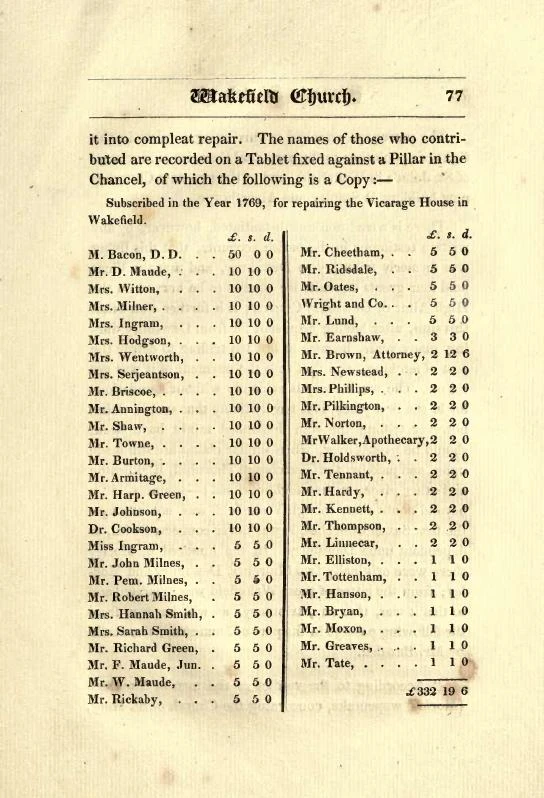
A further, firmly dated phase appears in Joseph Lawson Sisson’s 1824 history. He records that additions were made to the vicarage in 1769, when a subscription was raised to put it into complete repair. He copied the contributors from a tablet attached to a pillar in the church chancel. This is evidence of a repair and enlargement campaign during Michael Bacon’s incumbency, between the reported seventeenth-century rebuilding and the detailed property description of 1809.[21, pp. 76–77]
The printed total is £332 19s 6d. Bacon’s own £50 was the largest individual contribution listed. The remaining entries reveal a broad circle of local supporters, including numerous women recorded in their own right. The list below follows the printed page, with punctuation lightly regularised and uncertain readings marked. Initials and abbreviated given names have not been expanded into guessed identities. A donor’s contribution establishes support for the work, not residence in the house.[21, p. 77]
| Contribution | Contributors recorded by Sisson |
|---|---|
| £50 | M. Bacon, D.D. |
| £10 10s each | Mr D. Maude; Mrs Witton; Mrs Milner; Mrs Ingram; Mrs Hodgson; Mrs Wentworth; Mrs Serjeantson; Mr Briscoe; Mr Annington; Mr Shaw; Mr Towne; Mr Burton; Mr Armitage; Mr Harp. Green; Mr Johnson; Dr Cookson. |
| £5 5s each | Miss Ingram; Mr John Milnes; Mr Pem. Milnes [abbreviation uncertain]; Mr Robert Milnes; Mrs Hannah Smith; Mrs Sarah Smith; Mr Richard Green; Mr F. Maude, Jun.; Mr W. Maude; Mr Rickaby; Mr Cheetham; Mr Ridsdale; Mr Oates; Wright and Co.; Mr Lund. |
| £3 3s | Mr Earnshaw. |
| £2 12s 6d | Mr Brown, Attorney. |
| £2 2s each | Mrs Newstead; Mrs Phillips; Mr Pilkington; Mr Norton; Mr Walker, Apothecary; Dr Holdsworth; Mr Tennant; Mr Hardy; Mr Kennett; Mr Thompson; Mr [surname unclear in the scan]. |
| £1 1s each | Mr Elliston; Mr Tottenham; Mr Hanson; Mr Bryan; Mr Moxon; Mr Greaves; Mr Tate. |
Two occupational labels are particularly useful: Brown was identified as an attorney, and Walker as an apothecary. The list also distinguishes Hannah and Sarah Smith, three Milnes contributors and several Maudes. Those distinctions matter when following the names into wills, directories and family papers. The surname of the final £2 2s contributor is difficult to read in the scan and has been marked uncertain rather than assigned a confident spelling. Neither this list nor Sisson’s short account identifies the builder, assigns particular rooms to the 1769 work, or tells us whether the total subscribed equalled the final cost.[21, p. 77]
Reading the entrance and elevations
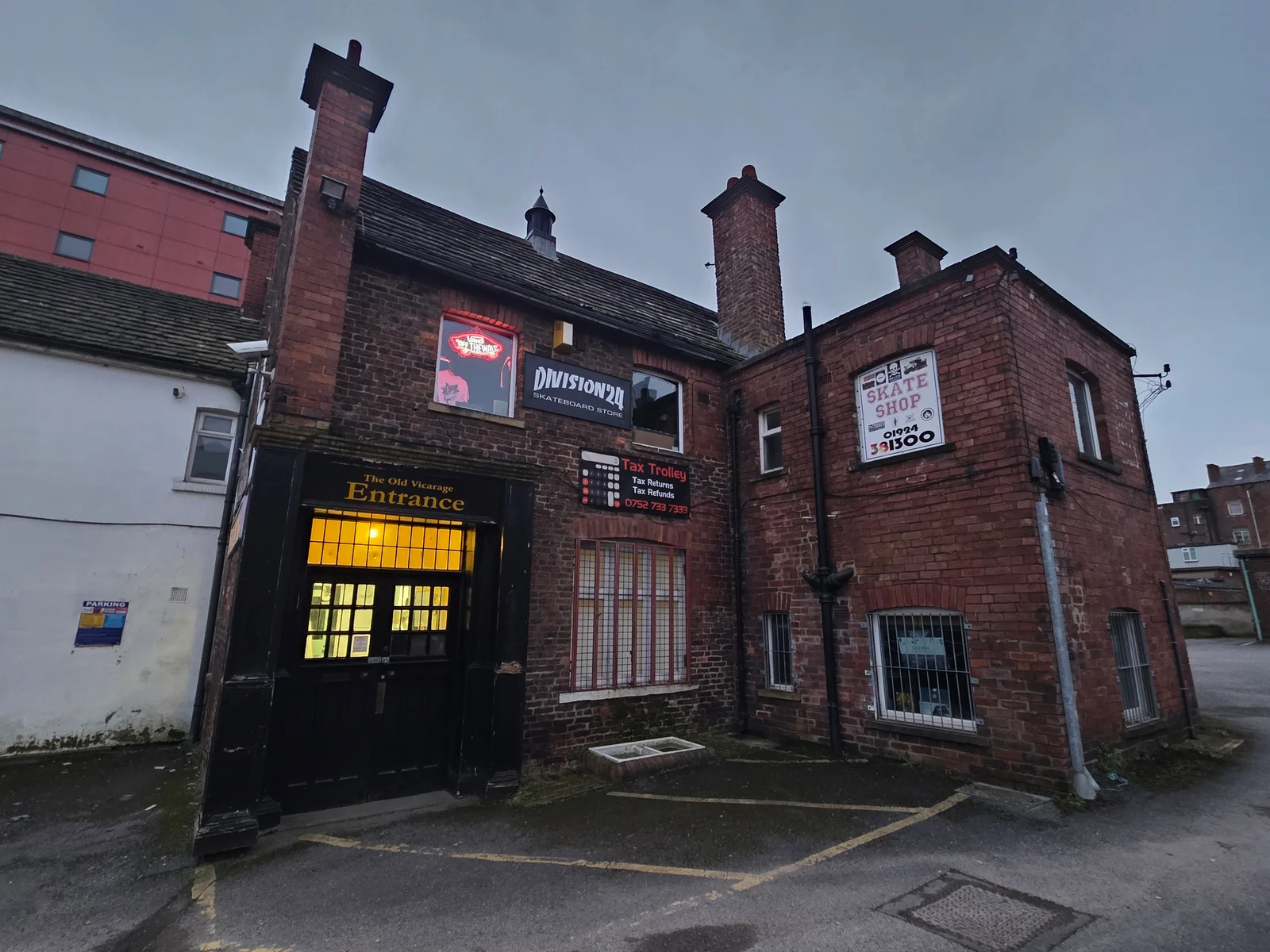
The entrance photograph supplied for this article provides a close view of the building in its commercial life. A black-painted doorway carries gold lettering identifying the Old Vicarage entrance. Glazed door panels and the illuminated rectangular overlight make the approach recognisable. Above and beside it are brick walls, several tall chimney stacks, pitched roofs and a projecting right-hand range. A white-rendered section adjoins the entrance side. These are observations from the photograph, not a dated reconstruction of earlier elevations.[30]
The visible fabric gives a future survey concrete features to investigate: the junction between the main range and the projecting wing; differing brickwork and mortar; the arches over window openings; the relationship of chimney stacks to roof slopes; and any changes concealed by render. The present doorway might preserve, replace or adapt an earlier opening, but a photograph alone cannot decide which. Tall chimneys indicate flues; they do not identify which rooms were bedrooms, kitchens or studies.
Modern signs, security fittings, pipes and window guards form part of the visible record of adaptation. In the supplied image, Division 24 and Tax Trolley signage can be read. The photograph documents those signs being present; it is not a complete tenancy list or proof of when either business began. The distinct evidence for modern occupants is set out in the commercial chapter.
Visitors can therefore recognise actual features without being offered a fictional medieval room plan. A building with several documented phases may retain old material in apparently ordinary places. Establishing that survival depends on recording the structure itself, particularly its concealed framing, roof construction, floor levels and wall junctions, alongside the historical documents.
Chapter 12The Georgian vicars: Scott, Arnet, Wilson and Bacon
Thomas Scott was instituted on 18 December 1700. His recorded educational route led from Wakefield Grammar School to Clare Hall, Cambridge, where he became a Cave scholar in January 1691–92. He was buried on 17 April 1729. George Arnet followed on 12 May 1729 and was buried on 16 October 1750. These relatively long incumbencies carried the parish through the first half of the eighteenth century, although the succession supplies little detail about changes within the house itself.[1, p. 193]
Benjamin Wilson became vicar on 10 July 1751 in Walker’s 1888 account. He had already served as headmaster of the grammar school, again linking the living with Wakefield’s educational establishment. He was buried on 6 September 1764. A later online succession mistakenly places his institution in 1764, the year of his death; this article follows the earlier account’s 1751 appointment.[1, p. 193] [3]
Wilson has also been associated with Dr Primrose, the central clergyman in Oliver Goldsmith’s The Vicar of Wakefield. Walker repeats the suggestion that Wilson supplied the model. It is an attractive literary connection, but the historical claim should remain a suggestion: the novel’s title and a local tradition do not, by themselves, demonstrate that Goldsmith based his fictional household on this building or its occupants.[1, p. 193]
Michael Bacon, instituted on 17 October 1764, held the living for approximately forty-one years. His church memorial records his death on 19 August 1805, aged 76. There is a small but important inconsistency within Walker’s book: the short biography uses 19 August as the burial date, whereas the register extract gives burial on 26 August. The memorial and register together support distinguishing the death on the 19th from burial on the 26th.[1, pp. 193, 212–213, 309]
His widow, Grace Bacon, survived him by more than twenty years. Her memorial records her death on 14 September 1827, in her seventy-ninth year. The inscription preserves a named woman connected with the clerical household, although it does not establish where she lived during widowhood or where she died.[1, pp. 212–213]
Bacon was involved in the establishment of the Sunday evening or Jane lectureship in 1801. Walker’s account describes resistance from parishioners who feared that an evening service would attract disreputable people under cover of darkness. The aged vicar’s reported response welcomed the opportunity to reach people who did not attend during the day. This is a recollected anecdote, rather than a verbatim contemporary transcript, but it gives the published portrait of Bacon more character than a list of appointments alone.[1, pp. 187–189]
The supporting deed, dated 26 June 1801, names Bacon alongside Robert Pugh, Thomas Rogers, William Hey, John Ridsdale, Thomas Rayner and Henry Dunderdale. The endowment drew on money left by Joseph Jane, formerly of Iron Acton. Thomas Rogers, the schoolmaster and first evening lecturer, was appointed on 16 July and delivered his first sermon on 26 July 1801. He should not be confused with the Thomas Rogers who had become vicar in 1462.[1, pp. 187–189]
Chapter 13Richard Munkhouse and a short, difficult incumbency
Richard Munkhouse was instituted on 20 September 1805, succeeding Bacon. He had been the first incumbent of St John’s, Wakefield, and his promotion to the parish living was associated with Lord Lonsdale. Walker reproduces an obituary account from the Gentleman’s Magazine, describing a man whose long earlier service was followed by severe illness soon after his advancement.[1, pp. 193–194]
According to that obituary, he had spent about twenty years as a curate and had twelve children, of whom seven survived him; the account mentions two sets of twins. It describes blindness and loss of the use of his limbs during his final years. These are unusually personal details in a succession otherwise dominated by degrees and institution dates. They reveal the burdens of a large family and declining health behind the formal title of vicar.[1, p. 194]
Munkhouse died in January 1810. His most substantial contribution to the surviving documentary picture of the house is the property return made during his incumbency in 1809. It allows the household’s physical setting and financial support to be described with much greater precision than is possible for most earlier periods.
A letter from the vicarage: the returned wine
A note dated from the Vicarage on 14 March 1809 provides a particularly direct glimpse of Richard Munkhouse at the house. The previous day, the vestry had resolved to restrict wine provision to specified purposes, including communion, officiating ministers and a dozen bottles to the vicar at Christmas. The associated minute names H. W. Hodgson, Joseph Hall, D. Maude, G. Ridsdale and Joseph Batty.[1, pp. 274–275]
When a dozen bottles were sent to Munkhouse, he returned them with a courteous but firm response. He thanked the churchwardens for their intention but declined the wine as a present: he believed that an established quantity belonged to the vicar by customary right. Walker prints both the note and the subsequent statement that the resolutions were reconsidered, rescinded and replaced.[1, p. 275]
The incident records correspondence issued from the vicarage and a disagreement over how the living was maintained. Alongside the property inventory, it reveals a household supported by negotiated customs as well as formal endowments, and gives Munkhouse a voice beyond the account of his illness.
Chapter 14Inside the vicarage in 1809: rooms, garden and income
A terrier was a written account of ecclesiastical property and rights. The Wakefield return submitted for the archbishop’s visitation on 23 June 1809 is reproduced by Walker, together with the name of Richard Munkhouse as vicar. It is one of the most valuable sources for the Old Vicarage because it describes the establishment as property in use, rather than as a later picturesque survival.[1, pp. 310–314]
The house was built of stone and brick and roofed with stone. The inventory lists thirteen rooms, a kitchen, brewhouse, cellar, stable and hay chamber. Its wording does not make it safe to calculate a modern total by adding every item to thirteen: the listed spaces are clear, but their precise grouping is not. What emerges unmistakably is a substantial domestic establishment with provision for food preparation, brewing, storage and horses.[1, p. 311]
The brewhouse is a particularly tangible detail. It places brewing among the household’s recorded facilities; it does not identify the brewer, the quantity produced or a commercial brewing business. The stable and hay chamber likewise show accommodation and fodder storage for horses, without telling us how many animals were kept. The cellar is documented, but this inventory does not describe a tunnel leading from it to the church.
The garden and croft amounted to approximately one acre and were enclosed by stone and brick walls. A smaller paddock behind, approximately one rood—a quarter of an acre—lay between a close and garden associated with Peregrine Wentworth. Its boundaries included paling, brickwork and hedge. These details restore an important feature of the earlier setting: the vicarage was a house with productive and enclosed ground, not simply the street-front premises familiar from later commercial use.[1, p. 311]
The terrier also explains how the living was supported. Its resources were scattered through the parish and combined older rights with payments attached to particular properties. They were not all rents from buildings beside the vicarage. A share of the tithe of Cliffield was associated with William Denison. Interest on £100 connected with Edward Watkinson was secured through a Westgate property associated with Thomas Crowther and its tenants. A fifth part of land associated with Richard Wilson produced an annual payment of £1 6s. 10d.[1, pp. 311–312]
Another forty shillings a year arose from a settlement of a dispute concerning the chancel, payable at Lady Day and Michaelmas. Five shillings came from the herbage of land called Deffers, near Kirkthorpe, occupied by John Smith, with payment at Easter. A further forty shillings under the will of Mr Smith of Heath supported two charity sermons, in June and December, and the catechising of children. The return identifies the latter benefactor by that limited form; a fuller first name should not be supplied without another record.[1, pp. 311–312]
Land allotted in place of small tithes included parcels at Whinney Moor and Outwood. The listed allotments include five acres, one rood and five perches at Whinney Moor; nine acres and five perches at Carr Gate; and eighty acres and one rood at Spring Well Hill. These are outlying endowment lands, not the size of the garden around the house. The distinction prevents the vicarage’s immediate grounds from becoming vastly exaggerated in a modern retelling.[1, pp. 312–314]
Read together, the return presents a household embedded in a complicated local economy: a house and garden near the church, practical service buildings, payments from named townspeople, charitable obligations and land elsewhere in the parish. It offers the strongest available basis for imagining daily life there, while stopping short of supplying an invented room-by-room tour.
A contemporary warning about the vicar’s income
Sisson introduced his copy of the 1809 terrier by challenging exaggerated claims about the value of the living. Writing in 1824, he argued that income varied and provided only moderate remuneration for the responsibilities of a large parish. That is the author’s contemporary assessment, rather than an independently audited household budget. It nevertheless explains why he printed a lengthy account of the house, land and payments: readers were being shown the financial arrangements behind the office, not simply an architectural description.[21, pp. 103–108]
The two dates must remain separate. Sisson published in 1824, but the terrier he reproduced described a return made in 1809. It cannot automatically establish that every room, boundary or tenant remained unchanged fifteen years later. This is also why a later book repeating an earlier inventory is not a second, independent inspection of the building.
Chapter 15Samuel Sharp: forty-five years and a clerical family
Samuel Sharp became vicar on 3 February 1810 and remained in office until his death on 9 March 1855. His connection with Wakefield had begun earlier, when he became a curate on 27 June 1804. Walker’s additional biographical account was supplied by Sharp’s son, Canon Sharp of Horbury, making it a family-informed account rather than an anonymous later tradition.[1, pp. 194, 315–316]
Samuel was born at Gildersome on 4 August 1773, the fourth son of John Sharp and Sarah, a daughter of Richard Hey of Pudsey. He was educated under the Reverend Hammond Robertson near Heckmondwike and then at Magdalene College, Cambridge. His uncle Samuel Hey was president of the college. Sharp graduated BA in 1796 and proceeded MA in 1799.[1, pp. 315–316]
He was ordained by Archbishop William Markham and served at Wheldrake. Another important family connection was his uncle Dr John Hey, the Cambridge Norrisian professor of divinity, whom he assisted at Passenham and Calverton. After moving to Wakefield as a curate, Sharp also held Edale from 1807 until taking the Wakefield living in 1810. His career therefore developed through education, family connections and pastoral appointments in several places before the long Wakefield incumbency.[1, pp. 315–316]
In 1810 he married Margaret Alderson, daughter of the Reverend George Alderson of Birkin. A Horbury local-history account gives the marriage date as 27 February and identifies their sons John, born 26 October 1810 and baptised at Wakefield on 7 November, and William, born 16 October 1812. Both sons later attended Magdalene College, Cambridge. These are family dates; the sources cited here do not establish the precise room or building in which either child was born.[1, p. 316] [9]
The length of Sharp’s incumbency is significant in itself. Between 1810 and 1855, the vicarage remained associated with one clerical head through more than four decades of nineteenth-century change. Yet a long tenure is not a complete household census. Servants, visitors, lodgers and temporary absences require census returns, accounts and correspondence of their own; their names should not be invented to make the domestic narrative appear fuller.
The sounds and public duties of Sharp’s parish
On 24 June 1815, the parish ringers received £2 2s. for celebrating Wellington’s victory over Napoleon at Waterloo. A September 1817 payment records £230 16s. to Mr Mears for new bells. These accounts help reconstruct the civic occasions and sounds surrounding the vicarage during Samuel Sharp’s incumbency.[1, p. 275]
Walker also describes public penance in the parish church on 25 August 1850. Following an Ecclesiastical Court sentence for defaming a woman, the penitent repeated a recantation after the vicar, after which the interested parties signed it. Earlier payments record the loan of sheets worn during penance, including one for Eliza Redhead in June 1737. Walker places the stocks on the north-west side of the churchyard and says they were last used in 1841. These practices belonged to the church and its public surroundings; they illustrate the range of authority exercised within the parish.[1, pp. 275–276]
Chapter 16Charles Joseph Camidge and the last clerical household
Charles Joseph Camidge was instituted on 7 November 1855. Born at York on 26 February 1801, he had served at Nether Poppleton from 1826 to 1855 and as an evening lecturer at St Margaret’s, Walmgate. Walker says that Lord Palmerston offered him Wakefield in August 1855 and that he initially declined. He subsequently accepted and became an honorary canon of Ripon in 1861.[1, pp. 194–195]
His family identification requires care. The main biography in Walker’s book calls him the son of Dr Camidge, the York organist, but an explicit correction in the additions states that he was the son of Matthew Camidge and brother of Dr Camidge. The corrected relationship is used here.[1, p. 319]
His wife was Charlotte, née Hustwick. A local study of the Camidge and Umpleby graves reports the couple at the vicarage in the 1861 census, providing a specific residential connection. That study also records Charlotte’s death on 7 September 1887, aged 77. It is a useful guide to family records, although some dates in its prose appear mistyped and require checking before reuse.[7] [8]
The household was closely associated with the restoration of the parish church. On 19 June 1860, Mrs Camidge laid the first stone of the rebuilt spire; on 22 November, their son Charles Edward Camidge, then an Oxford undergraduate, laid its top stone. In 1866, Charles Joseph and his wife presented a lectern in memory of a beloved son. Walker’s description of that gift does not name the son, so the memorial should not be assigned to a particular child without corroboration.[1, pp. 148, 155]
Charles Edward had been born at Nether Poppleton on 2 October 1837 and studied at Wadham College, Oxford. He served as a curate under his father at Wakefield: Walker dates that service from October 1862 to April 1868, while the Australian Dictionary of Biography places its beginning in 1861. He helped organise Wakefield’s Industrial and Fine Art Exhibition of 1865 and later became Bishop of Bathurst in Australia, being consecrated on 18 October 1887. This is a substantial overseas connection through the vicar’s family, without implying that the future bishop was born in the Old Vicarage.[1, curate succession] [7]
Charles Joseph’s final sermon was preached on 3 January 1875. He resigned on 20 May, retired to Leamington and died there on 10 February 1878, aged 76. He was buried in Wakefield Cemetery. His documented retirement and death away from Wakefield are important when assessing stories that place every former vicar’s death inside the old house.[1, pp. 194–195]
The craftsmen behind the Victorian restoration
The Camidge family’s involvement in the church restoration can be followed through named workers and contracts. Architect George Gilbert Scott recommended rebuilding the spire in a report dated 27 March 1857. Bishop Robert Bickersteth of Ripon chaired a Wakefield meeting on 16 April at which restoration was agreed. Walker records subscriptions exceeding £1,239 at the following luncheon, rising to £3,300 by the end of June.[1, pp. 145–147]
William Shaw of Stanley Hall offered stone from his Barnsley quarry, while J. C. D. Charlesworth and Joseph Charlesworth offered quarry stone too. The committee followed Scott’s preference for Milnesbridge stone. A £3,370 contract with Joseph Latham to reface the tower was signed on 20 May 1858, and Camidge laid its foundation stone on 17 July. A further £880 contract covered the spire’s reconstruction.[1, pp. 146–147]
Removal of the old spire revealed a copper case beneath the weather vane containing earlier parchments. One recorded the 1803 repairs during Michael Bacon’s incumbency and named stonemasons William and George Parkin, plumber Robert Greaves, brazier Jeremiah Clapham and whitesmith John Hampson. Found in the church rather than the vicarage, this record connects successive clerical households through the craftsmen maintaining their parish’s landmark.[1, p. 147]
The clergy who assisted the parish vicars
The household history belongs within a wider working parish. Walker’s list of curates names assistants who supported worship and pastoral care, sometimes moving on to neighbouring churches. It is reproduced selectively below to cover the long period when the Old Vicarage still served its clerical purpose. Appointment to a curacy does not establish lodging in the house. Where posts overlap, that can reflect multiple assistants rather than an error in succession.[1, pp. 195–197, 318–319]
| Period recorded | Named assistant and relevant detail |
|---|---|
| 1548 | Thomas Harrison and Thomas Turner, former priests of the Soothill chantry, appointed by the commissioners following the dissolution of chantries. |
| Later seventeenth century | Thomas Scoley, undated in this list; Obadiah Lee, curate in 1671; Miles Sandiforth, 1687–1691. |
| 1702–1737 | Daniel Sill licensed 15 February 1702; Thomas Settle, 19 July 1728; Thomas Dawson as assistant, 28 September 1737, with a stated stipend of £12 12s. |
| 1744–1769 | Joseph Wheeler licensed as assistant in 1744 and as curate in 1759; Thomas Beevor, 1755–1757; Jo. Armitage, 1761–1769. |
| 1761–1777 | Christopher Atkinson, from 1761 to about 1773; John Taylor, March 1769–June 1774; T. Hunter, July 1774–September 1776; James Watkins, October 1776–March 1777. |
| 1776–1797 | John Mackereth, September 1776–September 1787; John M. Freeman, September 1787–May 1789; William Wood, December 1791–June 1792; William Bawdwen, October 1792–June 1797, later translator of Domesday Book. |
| 1797–1816 | Gawen Brathwaite, July 1797–January 1804; Samuel Sharp, June 1804–February 1810, before becoming vicar; Henry Mitton, September 1810–August 1816. |
| 1817–1825 | William Snowden, July 1817–January 1818; J. L. Newmarch, February 1818–March 1823; G. W. Lewis, June 1823–September 1824; Thomas Kilby, September 1824–July 1825; Edward B. Bagshawe, July–December 1825. |
| 1826–1847 | John Pemberton Simpson, January 1826–December 1843; Thomas Ramsbotham, January–October 1844; John Kelly, February 1845–September 1847; Robert William Bilton Hornby, February 1845–March 1846. |
| 1848–1855 | Henry Jones, January 1848–May 1852; Edward Twells, October 1853–November 1855; William Pester Chappel, December 1854–November 1855. |
| 1855–1868 | A further Henry Jones entry, November 1855–February 1860; Edward Nicholson Stott, March 1860–January 1861; James Tanner, June 1861–May 1862; Charles Edward Camidge, October 1862–April 1868 in Walker’s chronology. |
| 1868–1876 | J. J. Needham, May–June 1868; William Townson, July 1868–August 1869; Michael Brown, September 1869–August 1870; Alfred Love, November 1869–September 1871; Arthur Richardson Meurant, October 1870–September 1871; Reginald Mottershead Hulbert, November 1871–April 1873; Allen Zechariah Grace, November 1871–December 1876. |
Several entries show how the parish supplied clergy to other institutions. Sharp appointed G. W. Lewis to the new church at Stanley and Thomas Kilby to St John’s, Wakefield. John Pemberton Simpson later became Rector of Crofton. These careers reveal a network of parish work extending beyond the walls of the vicarage, while avoiding the assumption that every assistant belonged to its domestic household.[1, p. 196]
Chapter 17From vicarage to Conservative Club
Norman Dumenil John Straton succeeded Camidge, being instituted on 2 August 1875. Born on 4 November 1840, he was the son of the Reverend George William Straton of Aylestone, Leicestershire. His education at Trinity College, Cambridge, was followed by ministry at Market Drayton and Kirkby Wharfe. His Wakefield career belongs to the transition towards cathedral status, achieved in 1888, rather than to a continuation of the old house’s domestic use.[1, p. 195 and additions] [4]
The later succession identifies Camidge as the last vicar to live in the Old Vicarage and states that Edward Green purchased it for conversion into a Conservative Club, which opened in September 1876. This provides the central transition in its later history: a building formerly tied to the parish household became a place of political and social association.[3]
Green was a significant figure in Wakefield’s industrial and political life. A National Trust collection record preserving his biographical inscription gives his birth as 4 March 1831 at 153 Westgate. He married Mary Lycett at Bowdon on 8 September 1858. Their sons were Edward Lycett Green, born 25 May 1860, and Francis William Green, born 25 November 1861. His family’s business interests were in engineering and iron founding.[10]
Green was elected MP for Wakefield in 1874 but unseated on petition, and returned to Parliament for the borough in 1885–1892. He became a baronet on 5 March 1886; consequently, calling him “Sir Edward” at the moment of the 1876 conversion would apply his later title retrospectively. He died on 30 March 1923 at Treasurer’s House, York.[10]
One particularly evocative survival links the former garden with the parish church. In 1888, Walker recorded that the large moulded base of the church’s 1661 font stood in the garden of the Conservative Club, which he explicitly identified as the former vicarage. This is direct near-contemporary evidence both for the club’s occupation and for a displaced piece of church furnishing in its grounds. It was the base of that seventeenth-century font, not proof of a medieval outdoor baptismal place. The cited account does not establish its present whereabouts.[1, p. 115]
A named glimpse of club life in 1911
The Savilian, the magazine of Wakefield Grammar School, supplies a small but concrete detail of the club’s social life. Its Michaelmas 1911 issue reports that H. Topham won the Wakefield Conservative Club Bowling Cup during the preceding summer. This gives the club a named participant and a dated recreational activity beyond its political identity.[23, p. 27]
Evidence and interpretation
The notice does not locate the bowling green, describe the competition or identify Topham’s role within the Conservative Club. Those details should not be inferred from the trophy’s name. Club minutes, membership books and contemporary plans would be needed to reconstruct how the old house and its grounds were actually used.
A visitor passes the club: February 1893
The Bell News and Ringers’ Record of 18 February 1893 contains an unusually vivid contemporary account, “With the Yorkshire Association at Wakefield”, by its unnamed special correspondent. After attending the cathedral, the writer went to Zetland Street schoolrooms for tea and a meeting. On leaving the schoolyard, the writer placed the old vicarage, explicitly identified as the Conservative Club, on the right before reaching a corner of the open market.[29, pp. 557–558]
The scene was far from a secluded clerical garden. Children ran around the edges of the crowd; sellers competed to make themselves heard. One offered supposedly gold watches for half a crown each, or two for four shillings. Another advertised pills and a cure-all mixture. Over the traders’ voices came the cathedral bells, their sound strengthening and fading in the wind. The writer finally hurried past the cathedral’s west front and along Westgate to catch a train.[29, p. 558]
Evidence and interpretation
The account gives a particular visitor’s impression, with humour and exaggeration, rather than a statistical description of the market. Its value for the house is the direct identification of the club and its relationship to nearby schoolrooms and public activity. The tea took place in the schoolrooms; it should not become a supposed banquet inside the vicarage.
The gathering also preserves names: W. Snowdon chaired the association’s business, supported by W. H. Howard, W. Stainthorpe, B. T. Copley and C. H. Hattersley. Archdeacon Donne responded to thanks for the welcome, and J. H. D. Hill, Vicar of East Ardsley, helped at tea. These were participants in the neighbouring event, not a recovered membership list of the Conservative Club.[29, p. 558]
Chapter 18The neighbouring Old Rectory and the making of Zetland Street
The Old Rectory and Old Vicarage must be distinguished. A detailed account of Wakefield Lodge’s jubilee, printed in the Freemason’s Chronicle on 28 April 1894, describes the lodge’s acquisition and eventual demolition of the rectory. Because the buildings were close to one another and shared an ecclesiastical setting, details from that account can easily be transferred to the surviving vicarage by mistake.[11]
The historical sketch was prepared by H. Oxley and Ellis Pickersgill and read by M. B. Hick. At the jubilee gathering, a surviving founder, Dr W. Statter, was said to be eighty-eight. The report therefore preserves an institutional history written within living memory of the lodge’s mid-century moves, although its account of much earlier origins is still retrospective.[11]
On 26 August 1853, the lodge decided to move from Thornhill Street to the Old Rectory. The purchase price was £300, with £24 contributed from lodge funds and the remainder raised in £10 shares. A further £200 was spent on adapting the property. The first meeting there took place on 14 September 1853. These figures concern the rectory purchase and adaptation; they are not the price Edward Green paid for the vicarage.[11]
The report describes access to the rectory through Vicar’s Croft, with carriage access from Doctors Lane, subsequently called Vicarage Street. Part of the property was taken to improve access to the new market. The resulting Zetland Street was named in honour of the Earl of Zetland. These details show the changing streetscape around the two ecclesiastical properties and help explain why their earlier grounds are difficult to reconstruct from the modern street pattern alone.[11]
On 22 April 1879, the lodge decided to replace its building. W. Watson was the architect; the committee included John Gill, W. B. Alderson and H. Oxley. Tenders were considered on 9 April 1880. The report gives a tender figure of £1,265 and a final cost of £1,558 17s. Those sums belong to the later replacement scheme, again separate from the £300 purchase in 1853.[11]
The last meeting in the old rectory took place on 13 April 1880, and demolition began the following day. The account says that the date 1348 was uncovered behind a ceiling and that an oak staircase was retained for the new hall. The discovery of a date was reported; its presence does not independently establish that every part of the demolished building had been constructed in that year. The new hall was in use on 9 November 1880.[11]
The present Masonic organisation identifies its Zetland Street hall with the 1880 building and records the formation of joint ownership by five lodges in November 1946, subsequently becoming six. This is the history of the neighbouring Masonic premises. The standing Old Vicarage was not the rectory demolished in April 1880.[12]
The rectory, a boarding school and the 1824 view
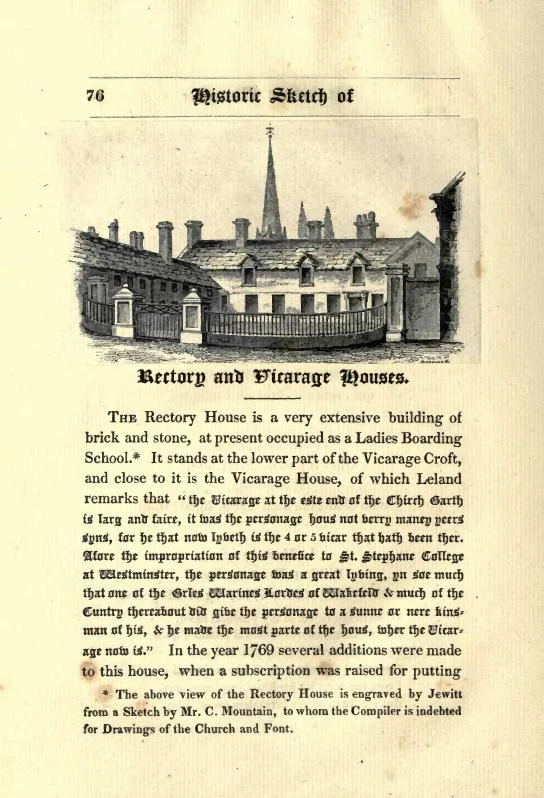
Before its Masonic use, the neighbouring rectory had another documented function. In 1824, Sisson described it as an extensive brick-and-stone building occupied as a ladies’ boarding school, at the lower part of Vicarage Croft, close to the vicarage house. His accompanying image carries the heading Rectory and Vicarage Houses; the footnote specifically calls it a view of the Rectory House, engraved by Jewitt from a sketch by C. Mountain. The complete page is reproduced here to preserve both the illustration and its explanation.[21, p. 76]
A directory adds names to this neighbourhood. The transcription of Pigot’s 1829 Wakefield directory places Samuel Sharp at “Vicarage”; under academies, it lists Martha Irvin, with a ladies’ boarding establishment, also at “Vicarage”. Under cabinet-makers and upholsterers, it records Joseph Balmforth as adjoining the vicarage.[22]
Evidence and interpretation
Read with Sisson, Martha Irvin’s entry is a promising lead for the nearby school, but the abbreviated directory address does not prove that her establishment occupied the surviving house. Nor does it conclusively identify her as the proprietor of the unnamed school Sisson saw five years earlier. Joseph Balmforth’s address explicitly places him adjoining the vicarage. These are useful named neighbours and research leads; moving them all into the same building would erase distinctions preserved by the records.
Vicarage Croft and a 1905 reburial proposal
West Yorkshire Archive Service’s account of the cathedral records identifies a 24 May 1905 citation concerning permission to widen Kirkgate: WDP3/14/7. Its reproduced text specified that human remains encountered when lowering part of the churchyard should be removed and reinterred in Vicarage Croft. The service also identifies a graveyard plan of about 1898, WDP3/21/5.[24]
This is a specific archival lead concerning the surrounding burial landscape. A citation setting out proposed works is not by itself a completion record. The exact receiving area needs to be located on plans before being equated with any present courtyard, garden or room at 24 Zetland Street. It does not establish burials beneath the surviving house.
Chapter 19Shops, creative use and a changing public life

According to information supplied in September 2026, the building’s community includes Pagan Magik, a new shop run by Angie and Mike; Tom Fletcher, who teaches music there; and Diane, who operates an online Vinted store from the premises. Together, they add retail, music teaching and online trading to the continuing story of the Old Vicarage.[20]
Commercial occupation forms another part of the building’s later history, alongside its political associations. Among the businesses associated with the building is Division 24, whose Wayne Miller told the Local Democracy Reporting Service that it had been there since 2001. That long trading connection gives the modern history named participants of its own, alongside the much older clerical succession.[16]
The building has also entered Wakefield’s arts programme. Artwalk’s venue record lists Old Vicarage events on 29 May and 31 July 2024, including activity under the name Hidden Gem. Later listings include work associated with Gaynor Haycock and photographs by Robert Clarke. These records document public creative use and the building’s continued ability to attract people into an older part of the city centre.[14]
Such uses matter to the history rather than merely following it as an afterthought. A former ecclesiastical residence became a political club, then a setting for independent trade and cultural activity. Each phase altered how people entered, experienced and remembered the building. Establishing the exact sequence of individual tenancies would require leases, trade directories and dated photographs; the available sources do not supply a complete unit-by-unit commercial register.
Chapter 20The tunnel story: what the surviving account actually says
One frequently repeated underground story survives in a 2006 online repost of a newspaper-style account headed “Old city labyrinth discovered by dog”. The repost names Dave Wiper of the Modern Savage Tattoo Parlour and his dog Sandy. It describes the dog entering an opening exposed during car-park work, with Wiper following into a cellar area associated with the Masonic premises. The account also mentions an electric light switch.[13]
Its interpretations differ. An unnamed Mason reportedly suggested a religious escape route connected with 1662. George Nairn-Briggs, then Dean, was presented as having heard the story but lacking proof. Local historian John Goodchild pointed to extensive cellars, while councillor Bryan Denson expressed belief in tunnels. The surviving page is a forum reproduction, not the original newspaper issue, so its original publication date and editing cannot be independently established from that page.[13]
The useful historical point is that an underground opening and interconnected cellar space were reported. An opening, however, does not establish the age, route or original purpose of every space beyond it. Nor do the different explanations offered by the people quoted amount to a measured survey. The reference to modern lighting suggests later access or adaptation, but cannot date the underlying masonry.
A secure tunnel history would need plans, photographs tied to known positions, inspection of blocked openings and comparison with demolished buildings and earlier property boundaries. Until then, a medieval passage to the cathedral, a seventeenth-century escape route and later interconnected cellars remain different propositions. The source supports reporting the discovery story and the debate around it; it does not settle those propositions.
Chapter 21The modern haunted reputation
The Old Vicarage’s current paranormal identity is documented through modern venue and event material. The Daily Detour Paranormal advertises bookings and presents The Vault, a collection associated with haunted-object stories. Wakefield Ghost Walk material also identifies the Old Vicarage as a destination connected with its tours. These are direct sources for how the venue is presented to visitors, rather than historical verification of supernatural activity.[17] [18] [19]
The Vault’s material includes Bob the Clown Boy, an object with a modern collecting and paranormal narrative. Such objects have histories of acquisition and interpretation that are separate from the building’s earlier inhabitants. A story attached to an object brought into the premises cannot establish that a corresponding person once lived or died there.[18]
The building offers an atmospheric setting without the need to manufacture a historical identity for every reported presence. Its documented story already contains sudden clerical succession in 1349, a vicar named in an attainder, religious displacement, family illness, memorial gifts and dramatic changes of use. No source cited here establishes a named ghost by matching it to an authenticated death in a particular room.
Accounts of footsteps, voices, sensations or apparitions would need to be attributed to identifiable witnesses or published reports if included in a fuller investigation record. They should retain the date and circumstances of the experience rather than being silently turned into events from the medieval or Victorian past. The historical article and the modern paranormal case record can sit alongside one another, each clear about what its sources demonstrate.
Chapter 22The 2024–2025 demolition controversy
The Old Vicarage attracted renewed attention in 2024 when demolition was proposed in connection with parking. Wakefield Historical Society argued that the building’s early origins and potentially surviving older fabric required serious investigation. Its statement emphasised the need for a historic-building assessment before its significance could be properly judged.[2]
Just Transition Wakefield also opposed demolition, combining heritage concerns with objections to additional parking and its environmental consequences. Its campaign page identifies the property as 24 Zetland Street. That page is an advocacy source: it records the campaign’s position and reasoning, rather than replacing the planning authority’s decision documents.[15]
Reporting published on 29 January 2025 stated that the demolition proposal had been refused because insufficient information had been supplied to assess the building’s historic significance. It described more than a thousand objections and identified Kevin Trickett, president of Wakefield Civic Society, among the opponents. Naeem Formuli, chair of the Conservative association, said that the proposal had been initiated by previous trustees and that the plan had been abandoned shortly after its submission in 2024.[16]
The report also identified continuing use by the local Conservative association alongside independent businesses, and local recognition without national listing in January 2025. Subsequent designation and management require later records.[16]
The controversy makes the remaining research especially consequential. A building can be historically important even when its construction sequence is imperfectly understood. In this case, uncertainty is a reason to investigate the surviving structure carefully: the documentary foundation, later fabric, garden history and neighbouring redevelopment together indicate a site whose evidence extends well beyond a single date on a sign.
Chapter 23Chronology of the house and its parish connections
This chronology distinguishes appointments to the living from dated changes to the property. An appointment is not, on its own, proof of residence.
| Date | Event and significance |
|---|---|
| 6 August 1348 | Edward III grants the patronage of Wakefield and Dewsbury to St Stephen’s, Westminster. [1] |
| 30 November 1348 | Archbishop William de la Zouch appropriates the church, reserving support for a vicar. [1] |
| 20–21 June 1349 | The vicarage ordinance specifies accommodation and income; Thomas de Drayton is instituted the next day. [1] |
| 8 October 1349 | Henry de Grenehod succeeds after Drayton’s death. [1] |
| 1362–1372 | John de Whytelay, John Stadefete and William Woderove appear successively in the living. [1] |
| 1416 | John Bolteby is recorded as vicar; Oliver Hulgar is known through a commemorative inscription, with uncertain placement. [1] |
| 1425–1443 | Robert Bever and John Lounde precede John Preston, instituted in February 1443. [1] |
| 1461–1462 | Preston is named in an attainder; Simon Stanffeld is appointed during his absence or infirmity. Thomas Rogers becomes vicar in September 1462. [1] |
| 1502–1537 | Thomas Knolles holds Wakefield; his wider career includes the presidency of Magdalen College. [1] [5] |
| 1546 and 1559 | Thomas Robertson, then Richard Robertson, are appointed. [1] |
| 1593–1625 | Edward Mawde, William Lister and Timothy Maude hold the living successively. [1] |
| 1625 or 1626–27 | Conflicting published dates for James Lister’s institution. [1] [3] |
| 1640s–1660 | Lister’s displacement; Commonwealth-era ministers include Nathaniel Cradock, Thomas Parker and Thomas Walker. Lister returns after Walker’s death. [1] [3] |
| 1677–78 to 1750 | Obadiah Lee, Thomas Scott and George Arnet hold the living in succession. [1] |
| 1751–1764 | Benjamin Wilson’s incumbency, following Walker’s earlier appointment date. [1] |
| 1764–1805 | Michael Bacon’s long incumbency. [1] |
| 1769 | Vicarage additions and repair subscription; Sisson lists contributors and a total of £332 19s 6d. [21] |
| 1805–1810 | Richard Munkhouse is vicar. The 1809 terrier describes the house, service buildings, garden and endowment. [1] |
| 1810–1855 | Samuel Sharp holds the living. [1] |
| 1853 | Wakefield Lodge moves into the neighbouring Old Rectory, a separate building. [11] |
| 1855–1875 | Charles Joseph Camidge’s incumbency. His family participates in the spire work of 1860. [1] |
| 1875 | Camidge resigns; Norman Dumenil John Straton succeeds. [1] |
| September 1876 | The former vicarage opens as a Conservative Club according to the later succession account. [3] |
| April–November 1880 | The neighbouring Old Rectory is demolished and the replacement Masonic Hall brought into use. [11] |
| 1888 | Walker records the base of the 1661 font in the former vicarage garden. Wakefield’s parish church becomes a cathedral. [1] [4] |
| 2024–2025 | Demolition controversy and reported refusal; see the dated accounts and qualifications above. [15] [16] |
Chapter 24What remains to be established
This account draws together accessible published records; it is not a substitute for a complete archive and building survey. Its strongest evidence includes the printed 1349 ordinance, the 1809 terrier, parish-register extracts, memorial inscriptions and the near-contemporary account of the separate rectory’s demolition. Its greatest remaining gaps concern the surviving structure’s construction phases and the complete sequence of domestic and commercial occupants.
The next documents likely to add substantive detail are the original glebe terriers and institution registers; deeds covering the 1870s transfer; census schedules with full household lists; probate inventories; Conservative Club minutes; the original 1908 architectural observations; historic maps and market-development plans; and the planning application’s submitted documents and decision notice. These records could resolve matters that the present published sources leave open. Located catalogue references are distinguished from full original documents inspected.
Dates around the beginning of the calendar year also need attention. English records before the calendar reform may use a year beginning on 25 March. Forms such as “1677–78” preserve that complication. A separate ten-year disagreement, such as the two published burial years for James Lister, cannot be explained simply by the old calendar. In that case, Walker’s register transcription gives additional support to 1677–78.
The history already recoverable is substantial: a medieval provision for a resident priest; a succession connected with national religious and political events; a working household documented through its rooms, brewing facilities and land; families whose lives extended far beyond Wakefield; and a building repeatedly adapted to new public uses. Further discoveries should add to that record with named evidence, rather than filling its gaps with assumed deaths, imagined residents or undated tunnel routes.
The next records, and the questions they can answer
Further depth depends on recovering particular documents. The following distinguishes known archive references from records still to be located, so that future additions can be checked against a clear research trail.
| Record or investigation | Question still to answer |
|---|---|
| 1769 repair tablet and any associated accounts | Does the original survive? Can it resolve difficult donor spellings, identify the builders and specify the additions? Sisson’s printed copy has been inspected; original accounts have not. |
| 1841–1871 census household schedules | Who actually slept and worked in the house: spouses, children, servants, visitors and lodgers? Full household lists require schedules tied to the correct property, rather than a list of vicars alone. |
| 1870s conveyance, sale particulars and plans | What did Edward Green acquire, from whom, at what price, and with which boundaries? No deed reference or purchase price for the vicarage has yet been established. |
| Conservative Club records | Who managed the premises, what alterations were made, where were recreation facilities, and when did club occupation end? Topham’s 1911 trophy notice supplies a dated lead, not a complete institutional history. |
| WDP3/21/5 and WDP3/14/7 | Compare the c.1898 graveyard plan with the 1905 citation, then seek a completion record and plan locating the proposed reburial ground. |
| 1908 architectural observations and a modern fabric survey | Who observed the timberwork, where was it, and what survives? Neither the medieval foundation date nor later exterior photographs can date each concealed component. |
| Commercial directories, leases and dated photographs | Build a year-by-year sequence of shops and occupants, distinguishing trading names from owners and tenants. A sign in a 2018 photograph is evidence for that photograph’s date. |
| First-hand accounts of the present building | Record move-in dates, room uses, alterations and experiences with the contributor’s permission. For paranormal reports, retain witness, approximate date, exact place and original account, alongside any ordinary explanations investigated. |
These gaps are left visible because they concern the very details that make a house history convincing: who occupied each space, what changed, and how we know. An unlocated deed, an unnamed servant or an undated experience should remain an open question until evidence supplies the answer.
The documentary recordSources and further reading
Numbers in the article link to the entries below. Printed page numbers refer to the original book, not the image counter in an online viewer. Historical books may contain transcription errors and later corrections; the OCR text is best read alongside the scanned pages when checking an exact spelling or date. Modern sources were consulted for this expanded account in September 2026.
- John W. Walker, The History of the Old Parish Church of All Saints, Wakefield, now the Cathedral Church of the Diocese of Wakefield (Wakefield: W. H. Milnes, 1888). Digitised book; searchable transcription. Principal source. Consult pp. 12–25 for the royal grant and vicarage ordinance; p. 115 for the font base; pp. 148 and 155 for Camidge family gifts and ceremonies; pp. 184–195 for lectureships and clergy; pp. 212–213 for the Bacon memorial; pp. 308–314 for registers and the 1809 terrier; and pp. 315–319 for additions and corrections. The digitised copy includes later additions.
- Wakefield Historical Society, “Proposal to Demolish the Old Vicarage, Zetland Street”, 26 April 2024. Read the society’s statement. Source for the apparent seventeenth-century rebuilding, reported 1908 discovery and argument for investigation. It is not a full structural survey.
- Wakefield Family History Sharing, “Rectors and Vicars of Wakefield”. Read the succession. Presents material from Walker’s later history with subsequent additions. Useful for the club transition and comparison, but contains discrepancies with the 1888 account. Conflicting dates are identified in the article.
- Wakefield Cathedral, “History”. Read the cathedral’s official history. Background to the parish church, medieval rebuilding and cathedral status.
- Dictionary of National Biography, 1885–1900, “Knolles, Thomas”. Read the historical biography. Adds his Magdalen career, dealings involving Thomas Cromwell and 1537 death. A historical scholarly biography, not a modern reassessment.
- Dictionary of National Biography, 1885–1900, “Robertson, Thomas (fl.1520–1561)”. Read the historical biography. Education, grammar writing, royal religious commissions and later appointments.
- Australian Dictionary of Biography, “Camidge, Charles Edward (1837–1911)”. Read the biography. Family background, Wakefield work and Australian episcopate. Its starting date for the curacy differs from Walker’s.
- Carol Sklinar, “Another walk around Sugar Lane—Camidge / Umpleby”, 14 February 2021. Read the family-history article. Census, cemetery and probate leads. Used selectively because some transcribed dates appear inconsistent.
- Horbury History, “Canon Sharp”. Read the local biography. Additional family dates for Samuel and Margaret Sharp and their sons; supplements the account supplied to Walker by Canon Sharp.
- National Trust Collections, Sir Edward Green biographical inscription, object 593159. View the collection record. Named family, political and life dates. The collection record reproduces an inscription rather than the vicarage purchase deed.
- The Freemason’s Chronicle, 28 April 1894, “Jubilee: Wakefield Lodge, No. 495”. Read the digitised issue (PDF). The jubilee account spans the fourth and fifth PDF pages and supplies dates, costs and names for the separate Old Rectory, its demolition and replacement.
- Wakefield Freemasons, “Wakefield Masonic Hall”. Read the hall’s history. Present institution’s account of the 1880 hall and twentieth-century joint ownership.
- Supernatural Earth forum, “Westgate, Wakefield”, 2006 repost. Read the reproduced underground-discovery story. A secondary reproduction of an unidentified original news report. Used for the reported story and attributed opinions, not as proof of a medieval tunnel.
- Artwalk Wakefield, “Old Vicarage”. View the venue and event archive. Dated cultural-use listings and named contributors.
- Just Transition Wakefield, “The Old Vicarage, 24 Zetland Street”, April 2024. Read the campaign statement. An openly campaigning source for the objections and address.
- Tony Gardner, Local Democracy Reporting Service, reporting on the Old Vicarage decision, 29 January 2025, published by Hits Radio. Read the report. Planning outcome, attributed comments, objections and Division 24’s occupation. The article is reporting about the decision, rather than the decision notice itself.
- The Daily Detour Paranormal, bookings. View the operator’s information. First-party evidence of modern visitor and paranormal use.
- The Daily Detour Paranormal, “The Vault”. Read the collection’s presentation. Used to document contemporary object stories, not to authenticate hauntings or historical residents.
- Wakefield Ghost Walk, events. View the event information. Modern tour context. Listings and availability can change.
- Scott, information supplied for this article, 11 September 2026. Names and present-day activities of Pagan Magik’s Angie and Mike, music teacher Tom Fletcher, and Diane’s online Vinted business. A contributor’s account supplied directly for publication. Artwalk’s July 2026 listing independently records Angie’s shop launch under the variant spelling “Pagan Magick”; this article retains Scott’s supplied trading name, “Pagan Magik”.
- Joseph Lawson Sisson, Historic Sketch of the Parish Church, Wakefield (1824). Digitised book; Complete scan (PDF). Printed pp. 76–77: rectory school, engraving, 1769 alterations and full subscription list; pp. 103–108: 1809 terrier and contemporary discussion of income. The two reproduced pages are public-domain historical material. Page 76 credits Jewitt’s engraving after C. Mountain.
- Pigot’s 1829 directory, Wakefield, transcription hosted by GENUKI/Colin Hinson. Read the directory transcription. Entries for Samuel Sharp, Martha Irvin and Joseph Balmforth. Abbreviated addresses are retained as evidence of locality; the original directory pages should be checked before resolving ambiguous occupancy.
- The Savilian, Michaelmas 1911, p. 27. Read the school magazine (PDF). Contemporary notice that H. Topham won the Wakefield Conservative Club Bowling Cup that summer. It does not give the green’s location.
- West Yorkshire Archive Service, “Wakefield Cathedral – The Parish Church”. Read the archive service’s illustrated account. Identifies c.1898 graveyard plan WDP3/21/5 and reproduces wording from the 24 May 1905 citation WDP3/14/7 concerning Kirkgate widening and proposed reinterment in Vicarage Croft. These references are supplied by the archive service; the full original files have not been inspected for this article.
- University of York, York Archbishops’ Registers, Register 10, f.32r entry 1 and f.30v entry 3. Read the source. Catalogue summaries confirming 20–21 June 1349 and naming the presenting canons. The unrelated name in the search URL is part of the catalogue’s indexed address; the cited entries concern Wakefield.
- University of York, York Archbishops’ Registers: Wakefield institutions and inductions. Read the source. Register 10 f.39r entry 5; Register 11 ff.116r, 153r and 166r. See also the 1372 exchange entry. Catalogue descriptions, not a new independent reading of the Latin manuscripts.
- University of York, York Archbishops’ Registers: Edward and Timothy Maude. Read the source. Register 31 f.139v entry 1 (continuing to f.140v), and f.256v entry 1. Catalogue dates and summaries for Edward’s will and Timothy’s administration. Both cite Yorkshire Archaeological Society Record Series 93 (1937), p. 50.
- Elizabeth Biggs, The College and Canons of St Stephen’s, Westminster, 1348–1548, PhD thesis, University of York (2016), vol. I, p. 56 and note 56. Read the source. Read volume I (PDF). Original scholarly research identifying Bolteby’s £32 debt and citing Calendar of Patent Rolls, Richard II, 1396–1399, p. 392. The underlying roll entry has not been independently inspected here.
- The Bell News and Ringers’ Record, vol. XI, no. 567, 18 February 1893, pp. 557–558, “With the Yorkshire Association at Wakefield”. Read the source. Digitised by the Central Council of Church Bell Ringers. Issue cover is PDF page 97; the report is PDF pages 99–100. Contemporary account by an unnamed special correspondent, including the club, schoolrooms and market.
- Entrance photograph supplied by Scott, 20260307_175345.jpg. Supplied for publication with this history. Used for observations of the visible entrance, elevations and signage. The filename is not treated as independent verification of the capture date. No Creative Commons licence is asserted for this contributor-supplied photograph.
Photographs and historical illustration
The opening entrance photograph was supplied by Scott for this history. The photograph of the illustrated sign is by Ian S, dated 18 April 2018, and licensed under Creative Commons Attribution–ShareAlike 2.0. The 1807 aquatint by I. Cawthorn is a public-domain work from the British Library. Captions identify the source of each image; links to public image records and reuse terms are included where available. The 2018 sign photograph documents that date, not the current tenant list. The header logo is artwork supplied by Scott for branding; it is not a historical view or an architectural reconstruction.